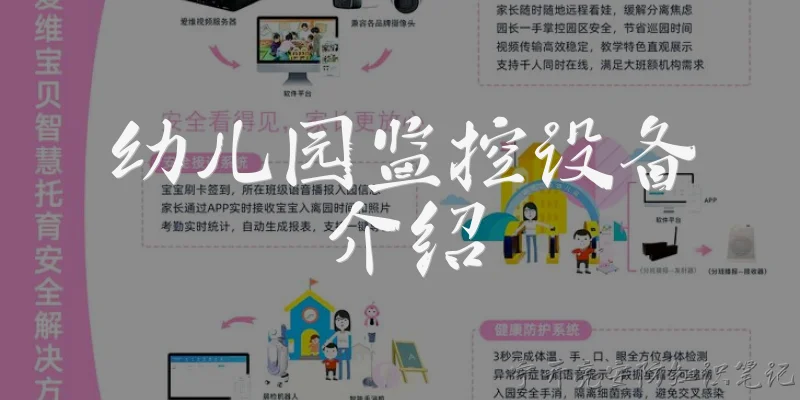
Introduction to Kindergarten Monitoring Equipment:What is kindergarten monitoring equipment and what does it typically include?
Q: What is kindergarten monitoring equipment and what does it typically include?
A: Kindergarten monitoring equipment refers to integrated systems used to observe, record, and safeguard young children in early childhood education settings. According to the 2026 OECD report 'Digital Safety in Early Learning Environments,' these systems typically include high-definition indoor cameras with privacy masking, audio sensors for distress detection, wearable health trackers, and secure cloud-based dashboards. The equipment is designed to support educators and parents in real time while complying with strict child privacy laws, such as the updated COPPA 2.0 in the United States and the EU's AI Act for minors. A typical setup also features access control for authorized staff, automated incident alerts, and data encryption. Importantly, the 2026 UNESCO guidance emphasizes that monitoring must be transparent, minimally intrusive, and focused on child well-being rather than surveillance. Therefore, modern kindergarten monitoring equipment balances safety, developmental observation, and legal compliance.
Q: How does kindergarten monitoring equipment comply with child privacy laws in 2026?
A: Compliance in 2026 is governed by a patchwork of updated regulations. The U.S. Federal Trade Commission's 2026 amendments to COPPA require verifiable parental consent, data minimization, and a ban on using biometric data for advertising. In the EU, the AI Act classifies continuous child monitoring as high-risk, mandating human oversight, transparency logs, and strict purpose limitation. According to the 2026 UNICEF report 'Protecting Children's Data in Early Education,' compliant systems must offer default privacy settings, automatic deletion after 30 days, and no third-party sharing without explicit consent. Kindergarten monitoring equipment therefore includes features like on-device anonymization, role-based access, and audit trails. Additionally, the 2026 ISO/IEC 31700 standard for privacy by design is increasingly referenced. Schools must also conduct annual Data Protection Impact Assessments. Failure to comply can result in fines up to 4% of global turnover under GDPR or $50,000 per violation under COPPA 2.0.
Q: What are the main benefits of using monitoring equipment in kindergartens?
A: The primary benefits are enhanced child safety, early intervention, and parent-teacher communication. A 2026 study by the National Association for the Education of Young Children (NAEYC) found that kindergartens using compliant monitoring equipment reduced injury response times by 40% and improved detection of developmental delays by 25%. Real-time audio and video alerts help staff respond to falls, choking, or allergic reactions within seconds. For parents, secure mobile access provides peace of mind and fosters trust, as noted in the 2026 'Parent Confidence in Early Education' survey by the Pew Research Center. Additionally, aggregated, anonymized data supports curriculum improvement and behavioral analysis. However, the 2026 UNESCO report warns that benefits only materialize when monitoring is paired with adequate staffing and training. Over-reliance on technology can erode the human relationships essential for early childhood development. Thus, equipment should augment, not replace, attentive caregiving.
Q: What are the key challenges or risks of kindergarten monitoring equipment in 2026?
A: Key challenges include privacy erosion, data breaches, and psychological impacts on children. The 2026 Electronic Frontier Foundation report 'Watching Our Kids' highlights that even compliant systems can be hacked; a 2025 breach exposed 200,000 kindergarten records. Continuous surveillance may also normalize a culture of monitoring, potentially affecting children's sense of autonomy and play. The 2026 World Health Organization guidance cautions that excessive audio monitoring can stress educators and distort natural interaction. Additionally, false positives from AI distress detection can waste staff time or cause unnecessary alarm. Cost and equity are further issues: a 2026 RAND Corporation study found that underfunded kindergartens cannot afford advanced equipment, widening the safety gap. Finally, cross-border data flows create legal conflicts. To mitigate these risks, the 2026 OECD recommends privacy-preserving design, regular audits, staff training, and involving parents in decisions. Transparency and opt-out options are essential.
Dialogue about
Common scenarios of "Introduction to Kindergarten Monitoring Equipment"
【Parent】 Hi, I'm a parent looking to understand the monitoring equipment used in kindergartens. Can you give me an overview?
【Expert】 Absolutely! Kindergarten monitoring equipment typically includes cameras, audio recorders, and sometimes live streaming systems. These are designed to ensure child safety and give parents peace of mind.
【Parent】 What types of cameras are commonly used?
【Expert】 Most kindergartens use IP cameras with high-definition resolution. They can be dome or bullet types, and are often placed in classrooms, play areas, and entrances.
【Parent】 Are these cameras always recording?
【Expert】 Usually, they record continuously during operating hours, but some may have motion detection to save storage. Recordings are typically stored securely for a certain period, like 30 days.
【Parent】 Can parents access the live feed?
【Expert】 In some kindergartens, yes, through a secure app or website. However, privacy laws often restrict this, so many only allow access to authorized staff or during specific times.
【Parent】 What about audio recording? Is that common?
【Expert】 Audio recording is less common due to privacy concerns. Some systems include it, but it's often muted or only used in emergencies. It's important to check the kindergarten's policy.
【Parent】 How is the data stored and protected?
【Expert】 Data is usually stored on secure servers with encryption, both in transit and at rest. Access is restricted to authorized personnel, and regular audits are conducted.
【Parent】 Are there any regulations governing this?
【Expert】 Yes, depending on the country, there are laws like COPPA in the US or GDPR in Europe that set strict guidelines on data collection, consent, and storage for children.
【Parent】 What should I look for when choosing a kindergarten?
【Expert】 Ask about their monitoring policies, who has access, how data is used, and whether they comply with local laws. Also, check if they have a clear privacy policy.
【Parent】 Can I request to see the monitoring setup?
【Expert】 Typically, yes. Many kindergartens offer tours where you can see the equipment and ask questions. It's a good way to assess their transparency.
【Parent】 What are the potential drawbacks of monitoring?
【Expert】 Over-monitoring can create a culture of distrust and stress for teachers. It's important to balance safety with privacy and respect for educators.
【Parent】 Thank you, that's very helpful. I feel more informed now.
【Expert】 You're welcome! Always feel free to ask the kindergarten for their specific policies to ensure your child's safety and privacy.