Video fusion equipment manufacturer:What does a video fusion equipment manufacturer do?
Q: What does a video fusion equipment manufacturer do?
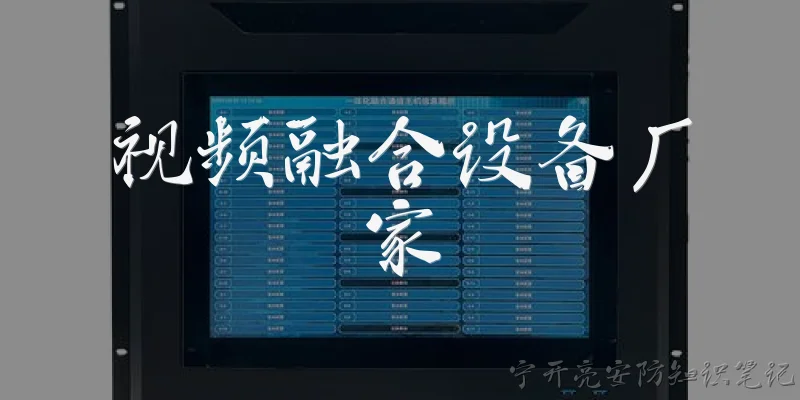
A: A video fusion equipment manufacturer designs and produces hardware that combines multiple video signals into a single, seamless output. These devices are essential in surveillance, broadcasting, and industrial monitoring, where operators need a unified view from different cameras or sensors. The manufacturer typically handles everything from circuit board design and firmware development to final assembly and testing. Key products include video matrix switchers, fusion processors, and multi-viewers. They also ensure compatibility with various video formats like HDMI, SDI, and IP streams. Beyond hardware, many manufacturers provide software for control, recording, and analytics. Their role is critical in security and command centers, where real-time, accurate video fusion can improve situational awareness and decision-making.
Q: How to choose a reliable video fusion equipment manufacturer?
A: When selecting a video fusion equipment manufacturer, start by evaluating their technical expertise and product portfolio. Look for manufacturers with proven experience in your specific industry, such as security, broadcast, or traffic management. Check for compatibility with standard protocols (ONVIF, RTSP) and support for high resolutions and frame rates. Request demonstrations or trial units to test latency, image quality, and ease of integration. Also, review their reliability records: mean time between failures (MTBF), warranty terms, and after-sales support. A good manufacturer offers firmware updates, technical training, and responsive customer service. Finally, consider scalability—can their equipment handle future expansion? Reading independent reviews and case studies can help you avoid vendors with poor quality control or limited support.
Q: What are the key features of video fusion equipment from top manufacturers?
A: Top video fusion equipment manufacturers typically include features like multi-channel input support (e.g., 4K HDMI, 3G-SDI, IP), real-time processing with low latency (under 100ms), and seamless switching between sources. Advanced models offer picture-in-picture, split-screen, and windowing capabilities. Many also provide edge blending for projector arrays and geometric correction. For security applications, features like motion detection, privacy masking, and alarm triggers are common. Remote management via web interface or API is standard. High-end manufacturers may add AI-based analytics, such as object tracking or facial recognition. Durability is another key aspect: rack-mountable chassis, redundant power supplies, and fanless cooling. Finally, interoperability with existing VMS or control systems ensures smooth deployment in complex environments.
Q: What industries rely on video fusion equipment manufacturers?
A: Video fusion equipment manufacturers serve a wide range of industries where combining multiple video feeds is essential. In security and surveillance, they enable control rooms to monitor dozens of cameras on a single screen for faster incident response. Broadcasting and media use fusion for live production, switching between cameras and adding graphics. Traffic management systems rely on fusion to integrate feeds from intersection cameras and ANPR systems. In industrial settings, fusion helps monitor production lines or remote assets. Military and defense applications use fusion for situational awareness and drone feed integration. Healthcare uses it for surgical displays and telemedicine. Even retail and smart cities adopt fusion for analytics and crowd management. Each industry has specific requirements, so manufacturers often tailor solutions for resolution, latency, and environmental ruggedness.
Dialogue about
Common scenarios of "Video fusion equipment manufacturer"
【Client】 Hi, I'm looking for a video fusion equipment manufacturer. Can you help me?
【Sales Representative】 Hello! Yes, we are a leading manufacturer of video fusion equipment. What specific requirements do you have?
【Client】 We need equipment for a surveillance system that can combine feeds from multiple cameras into a single seamless view.
【Sales Representative】 We specialize in that. Our fusion processors can handle up to 16 inputs and output a stitched panorama. What resolution and frame rate do you need?
【Client】 We're aiming for 4K at 30fps. Also, we need low latency for real-time monitoring.
【Sales Representative】 Our flagship model, the VF-8000, supports 4K at 30fps with latency under 100ms. It also has advanced blending and edge correction.
【Client】 That sounds promising. Can it handle different camera types, like thermal and optical?
【Sales Representative】 Absolutely. The VF-8000 supports multi-sensor fusion, including thermal, IR, and visible light cameras. It auto-aligns and calibrates each input.
【Client】 Great. What about the physical interface? We have limited rack space.
【Sales Representative】 It's a 1U rackmount unit, 19 inches wide. It has 16 HDMI inputs and 4 HDMI outputs, plus Ethernet for control.
【Client】 Is there any software included for configuration and monitoring?
【Sales Representative】 Yes, we provide a web-based GUI and a Windows application for setup, real-time monitoring, and firmware updates.
【Client】 What about power consumption and redundancy?
【Sales Representative】 It consumes about 150W typical. It has dual redundant power supplies for reliability.
【Client】 Can it be integrated with our existing VMS?
【Sales Representative】 Yes, it supports ONVIF and RTSP, so it can easily integrate with most VMS platforms. We also offer an SDK for custom integration.
【Client】 What's the lead time and warranty?
【Sales Representative】 Lead time is typically 4-6 weeks. Warranty is 3 years parts and labor, with optional extended support.
【Client】 Can we get a demo unit for testing?
【Sales Representative】 We can arrange a 30-day evaluation unit. Let me connect you with our technical team to discuss the details.