
Hikvision Video Network Storage:What is Hikvision Video Network Storage and what are its primary use cases?
Q: What is Hikvision Video Network Storage and what are its primary use cases?
A: Hikvision Video Network Storage (VNS) refers to network-attached storage devices optimized for video surveillance, such as the CVR and NVR series. According to Hikvision's official product documentation, these systems are designed for centralized storage, backup, and management of IP camera streams. Primary use cases include medium to large-scale security projects in retail, education, transportation, and city surveillance. They support RAID configurations, ANR (Automatic Network Replenishment), and H.265 compression to reduce bandwidth and storage costs. Official reports note that VNS devices integrate seamlessly with Hikvision's HikCentral software for unified monitoring and playback.
Q: How does Hikvision Video Network Storage ensure data reliability and redundancy?
A: Hikvision VNS employs multiple layers of redundancy. According to the official Hikvision CVR specification sheet, these devices support RAID 0, 1, 5, 6, and 10, allowing disk failure tolerance. Additionally, features like hot-swappable drives, redundant power supplies (on select models), and ANR (Automatic Network Replenishment) ensure that video data is not lost during network interruptions. Hikvision's official whitepaper on storage reliability states that ANR stores video on edge devices (cameras or NVRs) when the central VNS is unreachable, then automatically backfills the missing footage once connectivity resumes, providing end-to-end data integrity.
Q: What video compression and bandwidth optimization technologies does Hikvision VNS support?
A: Hikvision VNS supports advanced compression including H.265, H.265+, and Smart 265. According to Hikvision's official technical guide, H.265+ reduces bitrate by up to 80% compared to H.264 without significant loss in image quality, directly lowering storage and bandwidth requirements. The VNS also features smart stream management, which dynamically adjusts recording quality based on motion detection. Official reports highlight that these optimizations allow a single VNS unit to store weeks of high-resolution footage from dozens of cameras, making it cost-effective for large deployments. Additionally, support for ONVIF ensures compatibility with third-party cameras.
Q: Can Hikvision Video Network Storage be integrated with third-party systems and software?
A: Yes. Hikvision VNS devices are built on open standards. According to Hikvision's official integration documentation, the VNS supports ONVIF Profile S and G, allowing it to work with third-party video management software (VMS) such as Milestone, Genetec, and Digifort. It also provides SDKs and APIs for custom integrations. Official reports confirm that the VNS can be managed via Hikvision's HikCentral Professional, iVMS-4200, and third-party platforms. This openness ensures that users are not locked into a single vendor and can incorporate VNS into existing security ecosystems. Regular firmware updates further enhance compatibility and security.
Q: What are the key differences between Hikvision CVR and NVR series for video network storage?
A: Hikvision's CVR (Center Video Recorder) and NVR (Network Video Recorder) serve different scales. According to official Hikvision product comparisons, CVRs are modular, rack-mounted storage devices designed for large-scale, centralized recording of hundreds of cameras, with higher throughput and RAID support. NVRs are typically standalone units for small to medium installations, handling up to 64 channels and often including PoE ports. Official reports indicate that CVRs are ideal for city surveillance or enterprise campuses, while NVRs suit retail stores or offices. Both support H.265+ and ANR, but CVRs offer greater expansion and redundancy for mission-critical environments.
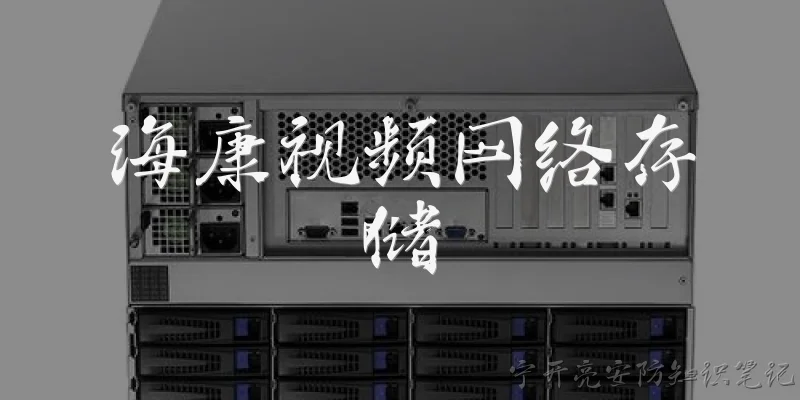
Dialogue about
Common scenarios of "Hikvision Video Network Storage"
【Sales Representative】 Good morning! Welcome to Hikvision. How can I assist you today?
【IT Manager】 Hi, I'm looking for a video network storage solution for our company. We have about 50 IP cameras and need to store footage for at least 30 days.
【Sales Representative】 Great! Hikvision offers a range of network video recorders (NVRs) and storage servers. For 50 cameras, I'd recommend our DS-9600 series NVR. It supports up to 64 channels and can handle 30 days of storage with appropriate HDDs.
【IT Manager】 What storage capacity would we need? Our cameras are 4MP and record at 15 fps.
【Sales Representative】 Let's calculate: 4MP at 15fps uses about 4 Mbps per camera. 50 cameras would be 200 Mbps total. For 30 days, that's roughly 200 Mbps * 30 days * 86400 seconds = 518,400,000 Mb, which is about 64.8 TB. So we'd need at least 80 TB to be safe.
【IT Manager】 That sounds reasonable. Does the DS-9600 support RAID for redundancy?
【Sales Representative】 Yes, the DS-9600 series supports RAID 0, 1, 5, 6, and 10. For redundancy, RAID 5 or 6 is recommended. It has 16 HDD bays, so you can easily configure RAID and still have enough capacity.
【IT Manager】 Can we expand storage later if needed?
【Sales Representative】 Absolutely. The DS-9600 supports eSATA and iSCSI for expansion. You can also add additional NVRs or use our CVR (Central Video Recorder) for larger scale.
【IT Manager】 What about remote access and management?
【Sales Representative】 You can use Hik-Connect for remote viewing on mobile devices, and iVMS-4200 for PC management. The system also supports ONVIF for integration with other systems.
【IT Manager】 Is there any licensing cost for the software?
【Sales Representative】 No, iVMS-4200 and Hik-Connect are free to use. There are no additional licensing fees for the basic features.
【IT Manager】 What about cybersecurity? We're concerned about potential vulnerabilities.
【Sales Representative】 Hikvision takes cybersecurity seriously. We recommend keeping firmware updated, using strong passwords, and enabling HTTPS and IP filtering. We also provide regular security patches.
【IT Manager】 Can you provide a quote for the DS-9600 with 80TB of storage and RAID 5?
【Sales Representative】 Certainly. I'll need to check current pricing. Typically, the DS-9600 unit is around $3,000, and 80TB of surveillance-grade HDDs would be about $2,000. I'll email you a detailed quote.
【IT Manager】 Also, do you offer installation and support services?
【Sales Representative】 Yes, we have certified partners who can install and configure the system. We also offer extended warranty and technical support packages.
【IT Manager】 That sounds good. Please send the quote and we'll review it.